.svg)
by
Yohance Harrison
May 12, 2023

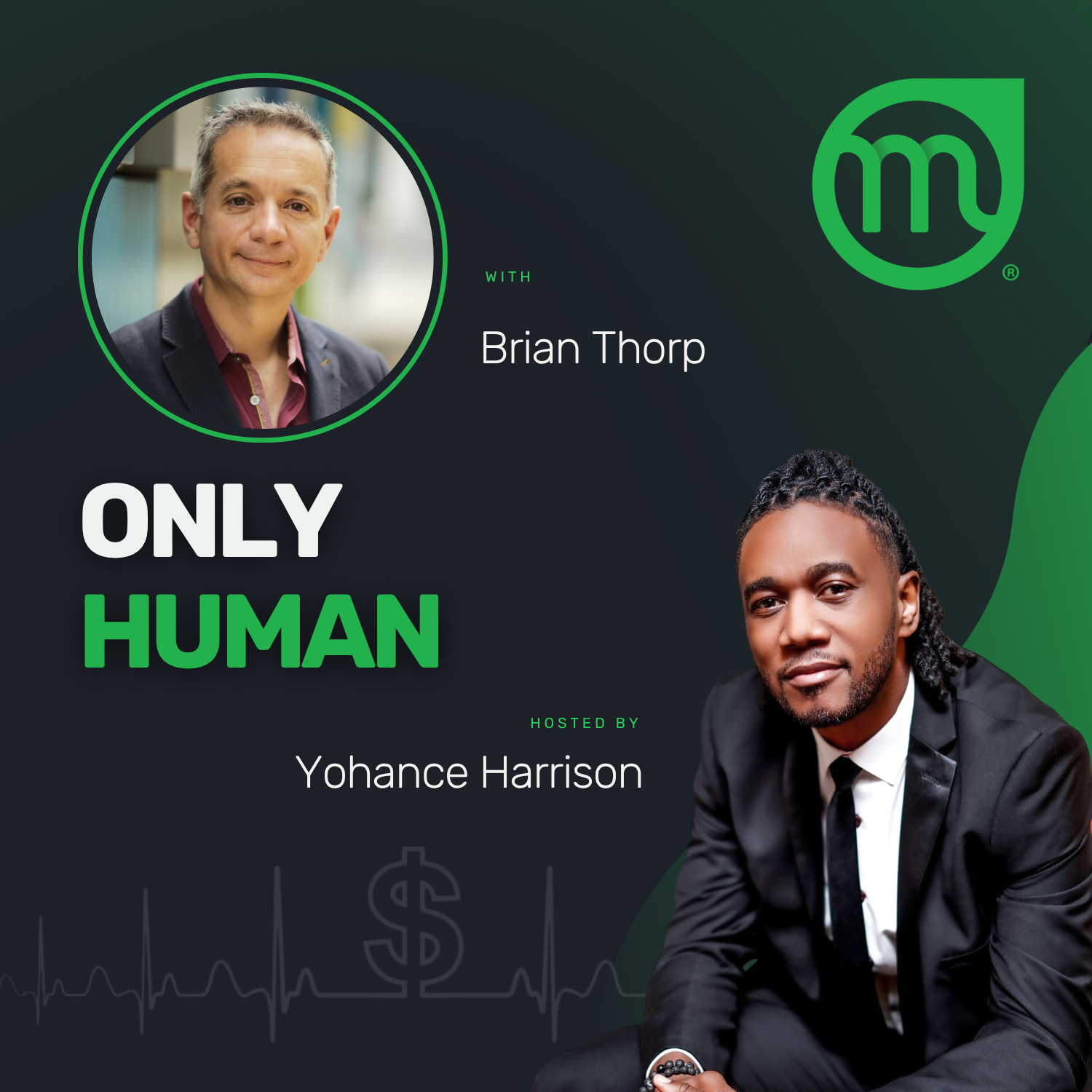
Financial advisors have spent years trying to answer a simple question: how do the right people find you online and trust you fast enough to take the next step?
That question sat underneath almost every part of this Only Human conversation between Yohance Harrison and Brian Thorp, founder of Wealthtender. Even though the episode covered online reviews, Google visibility, AI workflows, CRMs, and advisor websites, the throughline was pretty simple: the advisors who win aren’t just the ones with technical skills. They’re the ones who make it easy for ideal clients to find them, understand them, and feel confident reaching out.
Brian shared that Wealthtender came from noticing how consumer behavior had changed. People weren’t just looking for an advisor down the street anymore. They were increasingly using technology to search for someone who specialized in what mattered most to them (0:40). That shift sounds obvious now, but it changed the marketing game for advisors. Location still matters for some people, but specialization, trust, and digital visibility matter just as much.
That’s where reviews became a major inflection point. Brian walked through the long road from the SEC’s 2019 proposal to modernize the rules through the 2021 effective date, then the slower state-by-state catch-up process afterward (4:02). For advisors, this wasn’t just a compliance update. It changed how people evaluate financial professionals. In almost every other profession, consumers expect to read reviews before hiring someone. Financial advice was late to that world.
The practical point here is bigger than reviews themselves. Consumers want third-party proof. They don’t want only polished website copy. They want to know what it feels like to work with you. They want context, credibility, and reassurance. That’s why Brian’s explanation of compliant testimonials matters. Wealthtender isn’t just hosting praise. It’s creating a framework that helps advisors use reviews in a way that meets disclosure expectations while still serving the consumer (11:37).
Yohance added one of the best real-world examples in the episode. He talked about testing searches in ChatGPT, Gemini, and Google using terms like “financial advisor for physicians” and “Black financial advisor,” then seeing himself show up in the top results because of the work done through Wealthtender and related SEO efforts (16:27). He even shared that a client found him through ChatGPT while trying to solve a stock-option question and booked because his process was easier and faster than the alternatives (20:05).
That story highlights something a lot of advisors still miss. Visibility matters, but conversion matters too. Getting found is only step one. If a prospect lands on your site and can’t quickly tell who you help, what you do, what it costs, or how to book, the marketing work falls apart. Brian made this point clearly when he said advisors save time by making the prospect journey easier, not harder. If the website already answers basic questions about fit, services, and cost, the first meeting becomes more efficient and more productive (23:09).
This is one of the strongest thought-leadership ideas from the episode: transparency isn’t just a compliance or branding choice. It’s a time-saving system. It filters out poor-fit prospects and gives good-fit prospects confidence before the first conversation even begins.
The conversation also pushed past traditional SEO and into what advisors now need to understand about AEO, or answer engine optimization. Brian described the difference between on-site and off-site SEO/AEO. On-site is what happens on your own website. Off-site includes social platforms, directory listings, and third-party sites like Wealthtender that often have stronger domain authority than a typical advisory firm website (9:14). That matters because search behavior is changing. People still use Google, but they’re also asking ChatGPT, Gemini, and Claude for recommendations.
In plain English, this means advisors can no longer think of their website as the whole strategy. It’s one piece of the system. If your ideal client is using AI tools to search for an advisor, your visibility across trusted external platforms may matter as much as, or more than, what’s on your homepage.
Brian’s advice to advisors was direct: stop only Googling yourself. Start checking how you show up in ChatGPT, Gemini, and Claude too (24:44). That’s smart and increasingly necessary. AI search tools aren’t just summarizing websites. They’re shaping first impressions. Advisors who ignore that shift may not realize they’re invisible until growth slows.
The other big half of the episode focused on AI inside the business, not just in marketing. This part stayed practical. Brian talked about using Claude and Zapier to automate recurring workflows, systematize monthly tasks, and reduce the manual work that drags down teams (26:16). Yohance backed that up with his own experience: client review requests, referral emails, onboarding communications, Calendly workflows, and reminders are increasingly automated through connected tools like Zapier, Typeform, and Calendly (31:01).
That’s important because a lot of AI content aimed at advisors still lives in the abstract. This conversation didn’t. It stayed grounded in real operational pain points. What tasks repeat every month? Where are the bottlenecks? Which team member-dependent processes break when someone’s out for the day? Where can timing be improved with automation instead of memory?
Yohance gave a great example when he said automations keep the client experience moving even if a team member is unexpectedly out, because the client still gets the right nudge at the right time (32:03). That’s not hype. That’s operational resilience.
Still, both of them were clear-eyed about the limits. Automation doesn’t remove oversight. Yohance used a dishwasher analogy to explain it: if 90% of the dishes come out clean, you don’t stop using the dishwasher because 10% need a second look (33:28). That’s a useful mindset for advisors who either overtrust AI or reject it entirely. The better approach is supervised leverage. Let the tools handle the repeatable work, then review the outputs.
The most meaningful moment in the episode may have been Brian’s point that over 90% of the 6,000-plus reviews Wealthtender has helped collect aren’t about investment performance. They’re about the emotional side of the advisor relationship: confidence, peace of mind, retirement comfort, education planning, and having a plan for life transitions (27:57). That one observation cuts through a lot of industry noise.
For all the focus on dashboards, automation, analytics, and AI, clients still judge advisors largely on how they feel working with them. Do they feel understood? Do they feel less anxious? Do they feel organized? Do they feel clearer about the future?
That’s why this episode works as evergreen content. It isn’t really about tools alone. It’s about using tools to create more human capacity. The technology should reduce friction, improve visibility, and save time so the advisor can spend more energy on the moments clients actually value.
The “marry, divorce, date” segment made that point in a lighter way. Brian said he’d marry Zapier and Claude because of how deeply useful they are in daily operations (38:50). He said he was effectively scaling back HubSpot, not because it’s a bad platform, but because it becomes expensive when you layer on more features than you really need (39:22). And he said he’s currently “dating” Claude extensions and connectors to see what else can plug into the workflow without adding unnecessary complexity (40:39).
That’s a healthy framework for any advisor building a tech stack. Not every tool deserves a long-term commitment. Some tools are foundational. Some are too expensive for the value they create. Some are worth testing before fully adopting. If more firms treated software that way, they’d probably waste less money and move faster.
The final major theme was the future of advisor technology. When asked what dies first, the CRM or the financial planning tool, Brian gave a nuanced answer. He sees the CRM surviving only if it evolves into a much smarter system that absorbs AI note-taking and adjacent functionality (43:41). Otherwise, AI note takers may become the layer that matters most and simply pull CRM features into themselves.
That’s a sharp prediction and it fits where the industry seems headed. Advisors don’t care about categories as much as they care about outcomes. They want one system that helps them remember, document, prompt, and act. If a CRM can’t keep up with that expectation, it risks becoming a passive database while a more active AI tool becomes the operating system.
On financial planning software, Brian was more measured. He doesn’t think it disappears, because planning is still a core part of the profession (44:02). But he does think the winners will be the firms that integrate AI well rather than defensively gatekeeping it. That matters because every entrenched category eventually faces a “Blockbuster moment,” where a slower incumbent leaves the door open for a faster, more adaptive competitor (46:22).
For advisors, the takeaway isn’t that every legacy tool is doomed. It’s that platform risk now includes adaptability risk. If your key software vendors are slow to improve, resistant to integration, or weak in AI-enabled workflows, they may not age well. And if your business is deeply dependent on them, that becomes your problem too.
Brian also shared what’s next for Wealthtender: a “Firm Focus” page that works like a one-page site on Wealthtender’s stronger domain authority (35:50). That idea fits the whole conversation. Advisors need better ways to get discovered, especially if they’re constrained by clunky websites, firm-level restrictions, or niche audiences that need more targeted landing pages.
So what should advisors actually do with all of this?
First, check how you show up in AI search tools, not just Google. Second, make your website and intake process easier for prospects to navigate. Third, look for repetitive monthly tasks that should already be automated. Fourth, collect and showcase the kind of social proof that helps people trust you faster. And fifth, be honest about whether your current tech stack is helping you move forward or just preserving familiar frustration.
The strongest businesses in the next few years probably won’t be the ones using the most AI. They’ll be the ones using it most intentionally. That means better visibility, smoother systems, stronger trust signals, and more time for the actual human work.
That’s what this episode kept coming back to. Stay visible. Stay useful. Stay human.


.png)