.svg)
by
Yohance Harrison
May 12, 2023

What Will You Do With Your 10 Hours? AI, Productivity, and the Human Advisor
Artificial intelligence has become one of the loudest conversations in financial services, but this Only Human episode keeps bringing the topic back to something simpler: time, attention, and what it means to stay human in a profession built on trust.
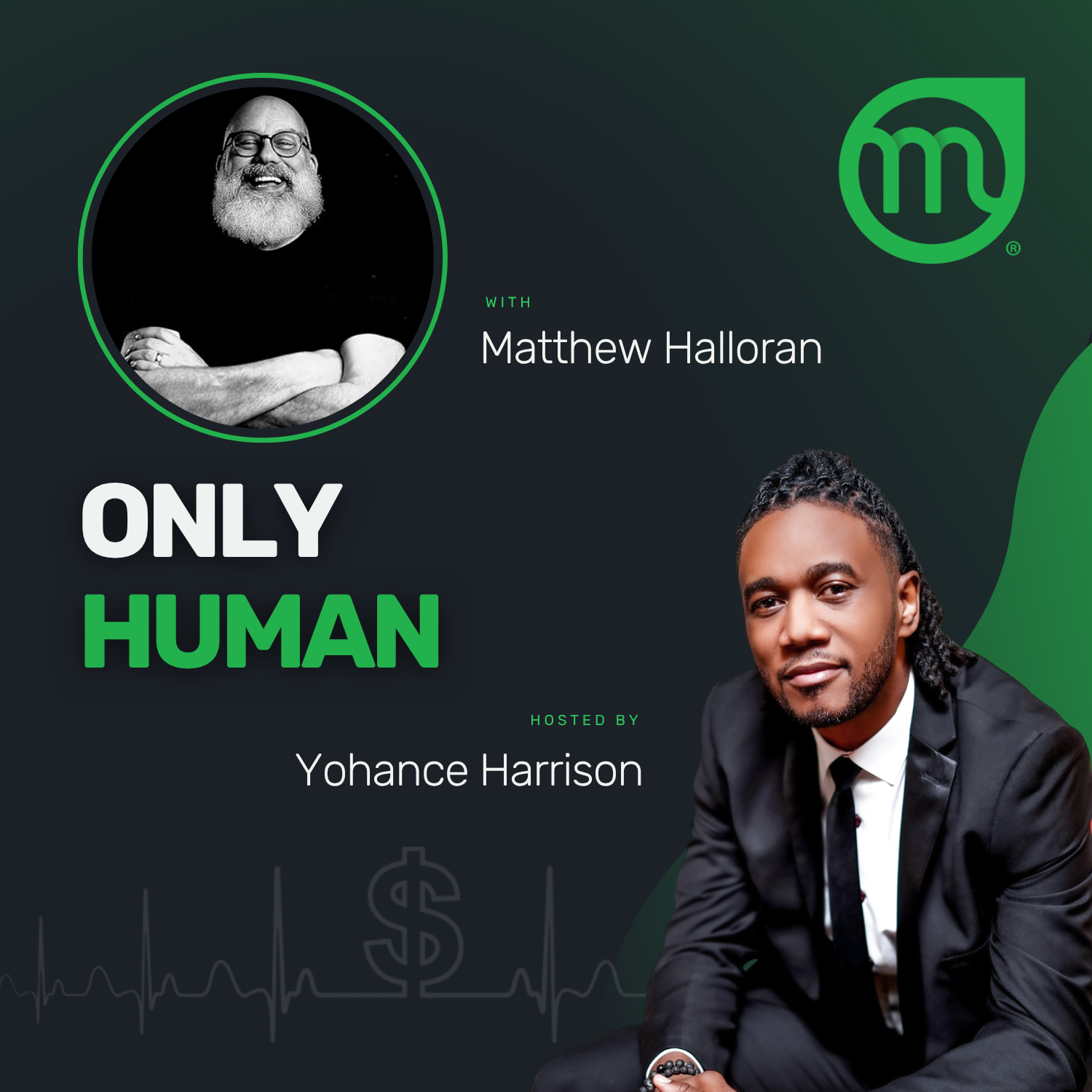
Yohance Harrison sits down with Matt Halloran for a conversation that covers advisor technology, practice management, client service, and change management. But the reason the episode works is that it never stays abstract for long. They keep grounding AI in ordinary life: coaching a daughter’s soccer team, following up faster with prospects, noticing a spouse’s facial expression on Zoom, getting home in time for dinner, or deciding whether to replace a staff role with automation.
That tension is what makes this episode useful. The conversation isn’t really about whether AI exists. Both of them are way past that. The real question is what advisors are going to do with it, and what happens if they don’t.
Matt’s own story gives the episode emotional weight right away. He explains that his move into Zocks followed a major life change after his wife became paralyzed. He had to step back from being a business owner and primary operator, and he needed a role that still let him do what he cared about most: help advisors communicate better, serve clients better, and build healthier businesses. That matters because it reframes what could have been just another “AI thought leader” interview. His shift wasn’t branding. It was personal.
From there, the conversation turns to the value proposition AI companies keep pushing: saved time. Matt says the 10-hours-a-week claim initially hooked him. Yohance doesn’t just agree in theory; he gives a lived example. He talks about using that recovered time to coach his daughter’s soccer team. The story is funny, personal, and concrete. The first season was rough. The next season got better. His daughter scored the game-winning goal. The point isn’t that AI creates better youth sports outcomes. The point is that when administrative drag comes off your plate, something real can take its place.
That becomes one of the strongest ideas in the episode: asking “What would you do with 10 extra hours?” is better than asking whether AI is impressive. It’s a more human question and a more strategic one. Advisors love to talk about efficiency, but efficiency by itself is empty. If the reclaimed time just gets filled with more noise, more meetings, or more low-value work, then the technology didn’t actually improve life or practice. It just sped up the treadmill.
Matt pushes this further with his “trade-off law,” the idea that every meaningful gain costs something proportionate. You don’t get everything for nothing. And among the things people trade away, time is the one resource they can’t make more of. That gives the AI discussion a sharper edge. In this framing, automation isn’t only about margin expansion or operational scale. It’s about whether advisors want to keep burning irreplaceable hours on tasks that machines can now handle competently.
That doesn’t mean the episode treats AI as magic. In fact, one of its most useful qualities is that it stays grounded in the messy middle. Yohance gives a practical example after an employee quietly checked out and eventually left. Instead of reflexively posting a job opening, he paused and used AI tools to think through the actual work being done. He describes one small process change around ADV and privacy-policy delivery that eliminated recurring manual effort. It didn’t replace the whole role, but it removed one repetitive task that had been consuming time every month.
That example captures a better way to think about AI adoption inside an advisory firm. The first question may not be “Which software should I buy?” It may be “What work is happening here that no longer needs to happen this way?” That shift matters. Advisors often evaluate technology at the product level before they understand the workflow level. But the workflow is where the real savings, client experience gains, and staffing implications show up.
The episode also lands on a point many firms still miss: AI is most powerful when it improves presence. Yohance talks about doing value work with clients and noticing facial expressions, pauses, and side conversations because he no longer has his head down taking notes. That’s a sharp reminder that great advisory work is not only technical. It’s observational. It’s relational. It depends on catching what clients hesitate to say directly.
This is where the phrase “AI won’t replace human connection” can either sound trite or ring true. In this conversation, it rings true because they explain why. AI can summarize. It can be drafted. It can extract tasks. It can route information. What it can’t do well is sit in tension, notice subtle discomfort, read a look between spouses, or hold emotional complexity the way a present advisor can. The technology becomes more valuable, not less, when it gets out of the way and creates room for that work.
That distinction matters for the future of financial planning. For years, advisors have competed on planning process, investment implementation, and responsiveness. Those still matter, but the episode argues they’re closer to table stakes now. Matt says the value advisors have leaned on for years is becoming easier to replicate or support with technology. What stays differentiated is the relationship itself. Not shallow friendliness. Real trust. Real memory. Real emotional intelligence.
At the same time, the conversation doesn’t let resistant advisors off the hook. Matt’s language gets deliberately sharp: those who keep sitting on the sidelines are “dinosaurs,” and “the asteroid’s here.” It’s a dramatic line, but it works because he’s not describing a distant future. He’s talking about a present shift in expectations. Clients are already using AI. Staff candidates increasingly expect it. Competing firms are integrating it. That means even if a reluctant advisor prefers not to engage, the environment around them is changing anyway.
That’s one of the best leadership takeaways from the episode. You don’t need to believe every AI promise. You don’t need to overhaul your firm overnight. But you do need to run the experiment. Advisors who wait for the tools to be perfect, universal, and frictionless will wait too long. Yohance and Matt are both clear that the tools still have bugs, incomplete integrations, and awkward edges. They spend a good chunk of the episode talking through exactly that, including data transfer issues, platform compatibility, and the speed of ongoing product changes.
That section is more valuable than a polished sales pitch because it reflects reality. Advisor tech adoption has always been uneven, and AI won’t be different. Some tools connect to one system but not another. Some do one thing brilliantly and another thing poorly. Some require a little imagination and process redesign to unlock their value. That’s normal. Firms that benefit most won’t be the ones waiting for seamless perfection. They’ll be the ones willing to test, adapt, and refine.
There’s also a broader cultural lesson here. Matt talks about adaptability as one of the defining skills that has helped him move through different stages of his career. His wife framed evolution not as survival of the strongest, but survival of the most adaptable. That idea fits the advisor landscape perfectly. The profession is full of smart, ethical, experienced people. But experience alone doesn’t guarantee relevance. The firms that stay strong will likely be the ones that learn fastest without losing their core identity.
That balance, learning fast without losing the human core, is probably the deepest theme in the episode. Both speakers are enthusiastic about AI, but neither is arguing for a less human profession. If anything, they’re arguing for the opposite. Use technology to reduce admin drag, improve follow-up speed, and streamline back-office work so advisors can be more attentive, more responsive, and more emotionally available where it counts.
The lighter “marry, divorce, and tech on the side” segment at the end reinforces this in a surprisingly effective way. Matt talks about Claude as the tool currently getting his attention, while ChatGPT is the relationship he can’t quite leave because it already contains so much of his thinking and history. It’s funny, but it also reflects a real challenge in AI adoption: these tools become useful not just because of their raw capabilities, but because people build context, habits, and workflows around them. Switching isn’t only technical. It’s behavioral.
That’s true for advisory firms too. The challenge isn’t simply choosing the best platform. It’s building repeatable ways to use that platform well. A great tool with no training, no process discipline, and no internal buy-in won’t do much. A decent tool used consistently in the right places can transform client service and advisor capacity. That’s why this episode keeps circling back to actual use, not abstract hype.
For advisors, firm owners, and industry leaders, the evergreen takeaway is simple: AI is now part of the operating environment. The strategic question is not whether to become a technology company. It’s how to use technology to become more effective at the deeply human work clients actually value.
That means better listening. Faster and clearer follow-up. More prepared meetings. Less scrambling. More presence. More capacity to notice what clients mean, not just what they say. More room to coach, reassure, challenge, and guide.
If the industry gets this right, AI won’t make financial advice colder. It will remove some of the friction that has kept advisors from doing their best work consistently. It will help strong firms scale care, not just output. It will give professionals a chance to reclaim time and decide, intentionally, what deserves it.
That’s why the best line in the episode may not be the asteroid comment, memorable as it is. It may be the quieter question underneath the whole conversation: what are you doing with your 10 hours?
That question belongs at the center of advisor technology strategy, leadership decisions, and even personal career design. Because once time comes back, you still have to choose where it goes. Into deeper client relationships. Into family. Into health. Into better thinking. Into building a more resilient firm. Or back into the same chaos that made the technology seem necessary in the first place.