.svg)
by
Yohance Harrison
May 12, 2023

Everyone Is Talking About SpaceX. Here's What They're Not Telling You.
By the time you read this, the SpaceX IPO may already be the most talked-about investment event of a generation.
On May 20, 2026, Elon Musk's rocket company filed its S-1 with the SEC, targeting a valuation between $1.75 trillion and $2 trillion. The ticker is SPCX. The roadshow starts June 4, pricing is expected June 11, and trading begins June 12. And if that wasn't enough this year is expected to host a list of the largest IPOs ever including OpenAI, Klarna, and Anthropic.
The hype is real. The excitement is understandable. But before you text or call your financial advisor, or log in to your favorite trading app to get in on the action. Stop. Take a breath. Ask yourself: Is that FOMO or facts?
Because those two things can feel identical at the moment. And confusing them is one of the most expensive mistakes an investor can make.
Something unusual is happening with the SpaceX IPO.
Historically, IPO allocations flowed almost exclusively to institutional investors: pension funds, mutual funds, and hedge funds. Retail investors were left to buy on the open market, often after a significant first-day pop had already priced them out.
Schwab, alongside Goldman Sachs, Morgan Stanley, BofA, Citi, and J.P. Morgan, is among the firms participating in this offering. That means everyday investors, not just institutions, may have a legitimate shot at receiving shares at the IPO price.
That is genuinely meaningful. But it also changes the question you need to ask.
Getting in at the IPO price isn't the finish line. It's the starting line. The real question is: what is this company worth, and what are you paying for it?
This is where herd mentality shows up early. When everyone around you is talking about getting in on the SpaceX IPO, your brain registers it as social proof. If this many people believe in it, it must be right. Right? That instinct has its place in life. In investing, it tends to anchor your decision to excitement rather than valuation.
Retail access doesn't eliminate that risk. It just moves it earlier in the process.
If you receive an allocation, ask yourself a harder question than "did I get in?" Ask: what does SpaceX need to earn, grow, and execute over the next decade to justify the price I'm paying today? If you can't answer that clearly, enthusiasm is doing the work your analysis should be doing.
Access is a privilege. Overpaying at the IPO price is still overpaying.
IPO hype has a way of crowding out memory. That's not an accident. It's a bias called availability bias. We overweight the vivid, recent story and underweight the base rate (what actually happens to most hyped IPOs over time).
So let's look at a sample of the base rate.
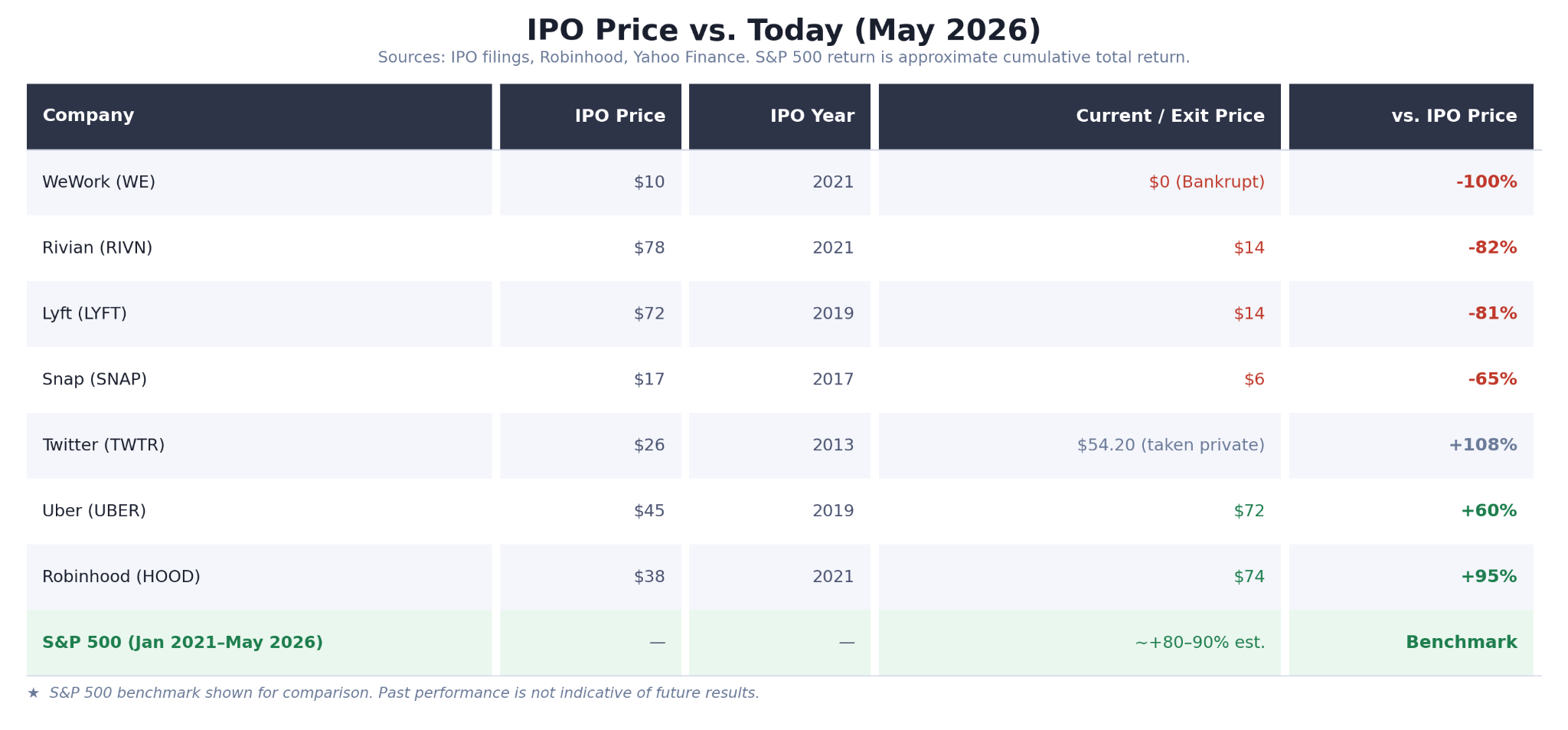
WeWork stumbled to a SPAC listing in 2021 at around $10 a share. It went bankrupt in November 2023.
Rivian hit the market in late 2021 at $78 per share. For a company that had barely delivered a vehicle, it was valued at more than Ford and GM combined. Today it trades around $14.
Uber IPO'd in 2019 at $45. It dropped on day one and spent years below its offering price before finding its stride. Snap went public at $17 in 2017, lost nearly half its value within months, peaked at $83 and today trades around $6. Lyft debuted at $72 in 2019 alongside Uber amid the ride-share frenzy. Today it's around $14.
Twitter went public at $26 in 2013. It stumbled, struggled to find profitability, and was ultimately taken private by Elon Musk in October 2022 at $54.20 per share. Shareholders got paid (finally). But it took nine years.
Twitter recovered, but required years of patience, not IPO day enthusiasm. WeWork, Rivian, Lyft, and Snap never came close to their IPO prices.
These were not obscure companies. They were featured in magazines, praised on financial TV, and celebrated as the next great thing. And that's exactly the problem. When everyone and their cousin is talking about the SpaceX IPO, we get anxious. We didn’t buy Bitcoin in 2013. What if we miss out, again? We start to feel like the outcome is more certain than it actually is. We reason our way into a decision that was really driven by emotion.
2021 was an all-time record year for IPOs, with 1,035 companies going public on U.S. exchanges. Many are now trading well below what investors paid on day one, some drastically so. The S&P 500, by comparison, gained an estimated 80-90% from January 2021 to May 2026. The average index investor quietly won. The average IPO buyer largely did not.
You can see the full 2021 IPO list at stockanalysis.com/ipos/2021/ and judge for yourself.
In fairness, some great companies had rocky IPO journeys too.
Facebook went public in 2012 at $38. Within three months, it had fallen to $18. Then came Instagram, WhatsApp, Oculus, and Threads. The Metaverse bet cost them $80 billion and nearly the narrative. META Platforms Inc. now trades north of $600 at the time of this writing.
Robinhood, the app that promised to democratize investing, debuted at $38 and traded as low as $6 within a year. Today it's recovered to around $74, though it spent years in the wilderness first.
Amazon IPO'd in 1997 at $18 per share and crashed 95% during the dot-com bust. The people who built real wealth from Amazon were not the ones who flipped it on day one. They were the ones who understood the business and held through years of losses, through years when the stock price told a very different story than the company's potential.
The formula for wealth isn't catching the IPO. It's time, patience, and conviction in what a company can become over a decade.
Let's keep it a hundred: the SpaceX valuation is either genuinely visionary or completely insane. Maybe both.
SpaceX is targeting a valuation of at least $1.8 trillion on listing day, larger than Microsoft, despite a $4.28 billion net loss in Q1 2026 alone and an accumulated deficit of $41.3 billion. Its prospectus claims a total addressable market of $28.5 trillion, just shy of U.S. annual GDP.
The vision includes orbital data centers, 42,000 Starlink satellites, and a self-sustaining city on Mars. Musk's compensation includes performance-based Class B shares that unlock only if SpaceX establishes a permanent human colony with at least one million inhabitants. Post-IPO, he holds 85% of voting power through a dual-class structure granting Class B shares 10 votes each. You will have an economic stake. You will not have a meaningful voice.
This is where the narrative fallacy takes over. Our brains are wired for stories, not spreadsheets. And SpaceX has one of the greatest stories ever told. It can override the numbers entirely. You stop asking "what is this worth?" and start asking "how do I get in?"
Musk has done things everyone said were impossible. Starlink has roughly 9 million paying subscribers and is growing.
But buying a company at $1.8 trillion, one posting billions in losses, controlled by one person, priced on the promise of a Mars colony, that is not investing. That is speculation. Nothing wrong with that. Just be honest about what it is. Is your interest in SPCX driven by rigorous analysis, or by the pull of one of the greatest stories of our time?
Only you can answer that.
Before the excitement of SpaceX, OpenAI, or the next great IPO pulls you in, sit with this question for a moment:
Am I investing in a business or chasing a headline?
I bought Mastercard on IPO day in 2006. I also bought DocuSign, Snowflake, and Teladoc on their IPO days. One of those stories looks like genius. Three of them sting. I've walked right into the behavioral traps I'm warning you about. I wrote about all four, with the real numbers and the honest lessons, in a companion piece here. It's worth a read before SpaceX starts trading.
Headlines create urgency. Businesses create wealth. Your financial security is too important to hand over to hype, to a story, or to the fear that everyone else is getting in on something you're missing.
If any of this has you thinking about your portfolio…what's in it, why it's there, and whether it's built for the next decade rather than the next quarter.
Let's talk.